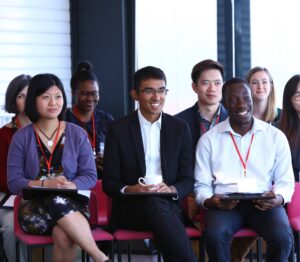
2011 Fulbright participants visiting Zhonghua Village in Chongqing
2011 Fulbright participants visiting China Welfare Institute
Since 1981, the National Committee has administered the Fulbright-Hays Seminars Abroad Program to China on behalf of the U.S. Department of Education. The program, as part of a Memorandum of Understanding between the Department and the Chinese Ministry of Education, is the first of its type, designed to give American educators an introduction to China’s history, culture, and society.
During the course of the five-week seminar, lectures and briefings by Chinese experts in a variety of fields are complemented by site visits to make the discussions more tangible. Following their return to the United States, all participants create curricula based on their experiences, which are made available as a resource for other educators around the globe. K-12 and higher education teachers and administrators participate in alternate years.
In summer 2013, a group of college level educators will travel to Beijing, Xi'an, Chongqing and Hong Kong, focusing on social sciences in China.
fulbright
Briefing Book Information
Click here to download the 2011 Briefing Book.
Application Information
Participants are selected through a competitive process managed by the United States Department of Education. For more information about the program and the application process, please go to http://www.ed.gov/programs/iegpssap/index.html.
Curriculum Project Introduction
Following their return from China, Fulbright-Hays Seminars Abroad Program participants are required to develop curriculum units or another type of curriculum-based project. These projects, which can be used by educators and administrators who did not participate in the program, are meant to educate students and community members about various aspects of China.
In order to facilitate use of these materials, the National Committee has divided projects according to their topic of focus. Please use the links below to locate the project that best fits your needs and interests. Projects listed cover a wide variety of grade levels and audiences. This information is noted in the project title.
Disclaimer
The curriculum projects posted on this site were prepared by participants in the Fulbright-Hays Seminars Abroad program. These projects are provided for general education purposes only, and their availability does not constitute or imply their endorsement or recommendation by the National Committee on U.S.-China Relations or the U.S. Department of Education.
U.S. - China Relations (Advanced Placement) by Allison Weller
This 2-week unit is developed to build upon the knowledge students already have of China from their previous social studies classes, but also to challenge any preconceived notions they have of China and help them gain a broader perspective of current international affairs. Beginning with a brief overview of China’s modern history leading up to Kissinger’s secret visit to China in 1971, and culminating with a mini-research project that allows students to analyze and assess the United States’ current policies relating to China, this unit plan will afford students the opportunity to truly grasp why there is such a fear in the U.S. today in regards to China, and perhaps more importantly, to understand the Chinese perspective of U.S. policies as well.
China - End of the Unit Activity (9th Grade) by Beverly Sweet
This lesson plan could be used to address the following New York State Common Core Standards for 9th grade Global History and Geography. This activity will be a fun way for students to summarize the material learned in the unit and prepare for the unit exam. It will also be effective in terms of both learning and motivation. It should maximize enjoyment (fun factor) without sacrificing instructional value and serve to reinforce concepts learned throughout the unit.
| China-End of the Unit Activity by Beverly Sweet.pdf |
China’s Relationship with Water — A Look at the Huang He River, Grand Canal and Three Gorges Dam (Middle School) by Carol Kirsch
This unit has been designed for middle school students studying Geography and History. The entire unit, which examines the Huang He, Grand Canal, and Three Gorges Dam projects, may be covered in two weeks. However, the teacher can easily shorten the unit by covering only one or two of the stand alone topics. If the teacher opts to cover more than one of the subject matters, it is recommended that afterwards a discussion be led to compare and contrast the topics and see if China’s approach to water control follows any kind of theme.
The focus of this unit is to help students comprehend the importance of China’s relationship with water and its great building projects in a way that is more meaningful to students.
| China’s Relationship with Water-A Look at the Huang He River, Grand Canal, and Three Gorges Dam (Middle School) by Carol Kirsch.pdf |
Learning About Chinese Culture through Local Myths (Elementary School) by Diane Blain
With a 5,000 year old culture, China has hundreds, maybe thousands of stories. How the world, solar system and people were created are just a few of these myths, but also fables teach morals, values and strategies. It is interesting to learn how myths and fables from China explain phenomenon and ethics and teach about the culture as well. An annotated bibliography of books and websites is included in order to help facilitate teaching this unit.
| Blain_Lesson Outline.pdf |
| Blain_Curriculum Framework.pdf |
The Great Wall of China - Past and Present (Middle School/High School) by Michael Plummer
While the principal focus is on China and the historical ramifications on the building of The Great Wall, a secondary goal is that of enabling students to get a better understanding of how similar projects in other countries, may have been developed for many of the same reasons, but with much more public debate. The ultimate goal of this unit is to make this topic accessible for blind and visually impaired students. With adaptive materials and resources, this unit will come to life.
| Plummer_Project Overview.pdf |
| Plummer_ Composition Rubric.pdf |
Confucius’s Legacy on the Chinese Character (College) by Trudi Swedlund
Faces and Places of China (Elementary School) by Stephani Hutchinson
Historical Geography of China (High School) by Janice Van Etten
This WebQuest is designed for high school freshmen studying world history. While the primary focus is on the historical development of China, a secondary goal is that of enabling students to understand the many geographic dimensions of the country.
| Introduction and Teacher Information.pdf |
| Student Handout.pdf |
| PowerPoint Presentation.pdf |
A survey of Chinese Architectural Styles & Structures (High School or above) by Paul Brissette
This lesson begins with a PowerPoint introduction to historic Chinese architectural elements, followed by a survey of significant ancient to modern Chinese architecture and structures. The teachers notes make reference to the political, religious and economic institutions that built these structures. The follow-up student projects are an optional addition for classes that deal with architectural drawing and design. The PowerPoint can be used with any secondary, or postsecondary intermediate art, architecture or social studies classes. The drawing portion of the project would require basic drafting and/or drawing skills typical in an art or architectural class.
China: Art and the Environment (College) by Laura Amrhein
Course ARHA 4310 (spring semester 2011) will analyze a wide range of paintings, sculptures, installations, and monuments which focus on nature and man's relationship to it. An important component in the course will be a consideration of art works that convey China’s artistic, social, and cultural attitudes or perceptions about nature and the environment. A four week unit China: Art and Environment will be included in the course. The unit will be included at the end of the semester in a section titled Global Considerations and the Impact of Developing Countries to allow students to incorporate previous material to consider environmental issues on a broader or global scale. The goal of this course is to expand student awareness of eastern art and culture, to expose students to ancient and contemporary works of art, and to engage them in a dialog about environmental issues on a local and global scale.
| Amrhein_Curriculum_Project.pdf |
New Models for Exhibiting Art in China (College) by Eleni Markopoulos
The goal of this project is to elucidate and comprehend nascent art institutions in 3 Chinese cities as exemplified by 7 case study institutions/organizations.
| Markopoulus_Curriculum_Project.pdf |
On Becoming American: Cinematic Representations of Female Acculturation (College) by Suzanne Lynch
This course attempts an in-depth analysis of cinematic representations of the marginalized female as she attempts to integrate into mainstream American culture. This course focuses on the adaptations of two films: Daughters of the Dust by Julie Dash and Joy Luck Club by Amy Tan and looks specifically at how these films represent the generational differences in coming to terms with and becoming a part of mainstream American culture. The selection of texts is designed to foreground and problematize the issues associated with the illustration and viewing of cultural representations and to address the similarities and differences represented between the Asian Other and the African-American Other in mainstream American society.
| Lynch_Curriculum_Project.pdf |
Everyday Calligraphy in China (Elementary School) by Denise Edelson
Chinese Contemporary Art as Social and Political Commentary (High School/College) by Clare Sisisky
Confucianism There and Here, Then and Now A Literature and Composition Unit (High School) by Cassie Nodine
This curriculum project is an exploration of Confucianism and its founder, as well as one of its seminal texts, The Analects, and how it pervades contemporary Chinese society and modern thought.
This project was written for a high school World Literature class, so emphasis is placed on the reading and interpretation of the text of The Analects, as well as synthesis and analysis of this text through composition. The course is arranged by regions of the world, and this project is included in the East Asia (China, Korea, and Japan) unit of the curriculum. In this course, students learn about the social, cultural, and historical aspects of regions throughout the world in connection with the literature. While this unit fits into a larger perspective of China and covers only Confucianism and its relation to literature in two weeks, students will receive a complete overview of Chinese history, culture, and literature by the end of the East Asian unit, which is six to eight weeks in length.
Students will already have a working knowledge of textual analysis and interpretation, as well as a basic grasp of essay writing and MLA formatting, which will be incorporated in this unit, upon beginning this course of study.
Genre Study - Memoir (7th Grade) by Jodie K. Scales
Language Arts teachers have used literature as an effective means of instruction when attempting to open their students' understanding of the world. As indicated in the lesson plans I intend to apply my newly acquired understanding of events which took place in East Asia to give students a more personal contact through mentor text (specific passages selected as model examples of the genre) and literature selections that will be age appropriate to the seventh grade student while leading to deep thought and integration of the similarities and differences of specific cultural experiences. This will be done with such memoir books as Red Scarf Girl by Ji-Li Jiang, and Snow Falling in Spring by Moying Li.
| Genre Study - Memoir by Jodie K. Scales.pdf |
Symposium on Globalizing the Curriculum (College) by Solange Lopez-Murphy
A Comparison of the Traditional Chinese Characters (Kanji) and the PRC's Simplified Characters (College) by Yoshimitsu Khan
Literature and its Connection to Understanding China (College) by Elaine Cho
In addition to reading various genres of literature from Asian American writers, students will also learn about the history, culture, and social issues in relation to Asia and the Asian American experience.
| Cho_Curriculum_Project.pdf |
| Cho_Curriculum_Project_Presentation.pdf |
Impressions of China: Using Contemporary Short Stories to Expand Cultural Horizons (College) by Carol Osborne
In China We Say (College/High School) by Nell Tiller
Common Chinese expressions or proverbs have been used even in the English language to illustrate a point or explain something cultural. The expressions in this list are a combination of old and contemporary. Each adds to the understanding of the culture and history of China, especially China of the last fifteen years.
| In China We Say_Syllabus.pdf |
| In China We Say_Slides.pdf |
20th Century China and the Contemporary Chinese Novel (College) by Jewell Mayberry
This is a course for upper-level liberal arts major with no previous study of China. Through this course, students will receive an introduction to the history, politics, culture, and arts of 20th-century China through the study of six contemporary Chinese novels. All novels are written in English or translated into English. Films are in English or in Chinese with English subtitles.
| Mayberry_Course Outline.pdf |
Tang Dynasty Poetry: Introduction and Reflection (High School/College) by David Freedholm
This project began with my experience on the 2007 Fulbright-Hays Seminars Abroad to China trip. Knowing that we would be visiting places in China relating to the Tang Dynasty (primarily Xian) and wanting to immerse myself more in Chinese culture and poetry, I brought with me several volumes of Tang Dynasty poems. As we traveled and as I read the poems, they became a catalyst for reflection upon my experience. I then began writing a journal based on these reflections which I published in blog form on the internet.
| Project Introduction.pdf |
Bringing China Into the Classroom (Middle School) by Susan Casler
Light in the Water: Understanding the Importance of Poetry in Chinese Society (Elementary School) by Terri Toppler
Copies of Terri's PowerPoint presentation, complete with notes and audio files, are available from the National Committee. Should you be interested in receiving a copy, please send an email to info@ncuscr.org.
| Project Introduction.pdf |
The China Gap-Digital Video Production (AP Human Geography) by Tara Rigby
The project is specifically designed for High School level students enrolled in Advanced Placement Human Geography. The Human Geography curriculum is thematic in nature and focuses on theories and models that can be applied to all regions of the world. At the onset of this project, students will have completed instruction in all of the areas featured in the case study. In addition, students will have developed skills in the spatial analysis of a variety of concepts. Therefore, the objective is to assess their level of mastery over the content as they apply their understanding specifically to China. For Human Geography, this would be completed as an end of year assessment.
The project plan focuses on technology and writing. Within this framework, students will be required to work collaboratively with a partner to coordinate their knowledge of China’s changing position within our global society. Through the process of digital video production, students will use China as a case study example to demonstrate their knowledge of culture, population, migration, political geography, economic geography, and resource issues. Then, through the process of writing and editing, they will develop a narrative to accompany the photo or video segments within their story.
Life Span Human Development in China: An Ecological Perspective (College) by Hakim Rashid
This project will use Urie Bronfenbrenner’s Ecological Theory to examine issues related to life span human development in China. It will examine historical, cultural and political forces on the contexts and processes of human development from early childhood through adulthood and into the aging population.
| Rashid_Curriculum_Project.pdf |
| Rashid_Curriculum_Project_References.pdf |
| Rashid_Curriculum_Project_Presentation.pdf |
The Use of Chinglish in Public Signs in China (College) by Kashama Mulamba
Students will
1. develop an appreciation of the importance of communication in Chinglish;
2. understand that “Chinglish” is not a variety of English as any other world variety of
English;
3. see the connection between Chinglish and the historical events (e.g., opening to the
outside world);
4. understand that Chinglish is necessary despite the fact that it is not a variety of
English;
5. see a possible relationship between the use of Chinglish and the Chinese way of life.
| Mulamba_Curriculum_Project.pdf |
Contemporary Surroundings and Local History in Select Cities in China (College) by Barry Davidson
This curriculum unit is intended for use by university graduate education students who are interested in or may soon be visiting China. The project is based on a series of short literacy tests which should lead into further study on local history in China.
| Davidson_Curriculum_Project.pdf |
Media Law in China: A Comparitive Analysis of Defamation Law in China and the United States (College) by Mark Shifflet
The purpose of this curriculum project is to provide material for educators who wish to increase student awareness of China’s media and its unique development within a communist political system that is transitioning to a market economy. It will also provide students with an appreciation of the complexity of the relationship between the media and legal systems of China through an analysis of a major area of media law, defamation.
| Shifflet_Curriculum_Project.pdf |
Doing Ethical Business in China: Human Resource Management (College) by Elizabeth D. Scott
Students will be able to identify values that are emphasized in China and articulate how those values affect business decision-making with respect to employees. Students will understand how Chinese national culture affects human resource management decisions.
| Ethical Business in China.pdf |
General Stilwell, Wartime Chongqing, and American Foreign Policy to World War II China (College/HS) by Meredith Heiser-Duron
The audience for this project could be either high school students, community college students or university students. The purpose of this project is threefold. First, students will improve their historical and foreign policy knowledge of China and the U.S. in World War II. Students will also better understand the domestic and international reasons why President Roosevelt and Generalissimo CHIANG Kai-Shek both vacillated in their World War II policies. More generally, students should understand the impact of culture on foreign policy and diplomatic relations.
| Heiser-Duron_Project Outline.pdf |
| Heiser-Duron_Student Project.pdf |
Gender and Family in China: New Roles for Women (College) by Robin Smith
This curriculum project is designed to provide guidance and support for an ethnography on rural China in an introductory level course in cultural anthropology.
| Smith_Project Outline.pdf |
Teaching Cultural Psychology–A Course Syllabus and Unit on Abnormal Psychology with focus on China (College) by Karen Edwards
This course examines culture as process. Emphasis is placed on the interaction of culture in various contexts. Particular attention is paid to the relationship of cultural identity and psychology as well as mental health issues.
| Edwards_ Course Outline.pdf |
Chinglish: an illustrated lecture (College/High School) by William Griffin
The McDonaldization of China (College) by Lynn Guenette
This curriculum project explores the history of Scientific Management in China and the U.S. It also looks at the concept of McDonaldizaiton and how McDonalds has had to adapt to succeed in China. It explores how Chinese customers have changed as a result of exposure to McDonalds. Although Yum’s has been operating in China as Kentucky Fried Chicken for a longer time and has more restaurants in China than McDonalds, the focus of this paper is McDonaldization and McDonalds was the first business to employ Scientific Management to the food industry. While this type of business management can increase efficiency, there are negative consequences of “going too fast”. The paper concludes by looking at some of the negative consequences of the Chinese people adopting Western eating habits and lifestyles.
| Guenette_Project Outline.pdf |
Perspectives on Cultural-Sustainability, National Unity and Multicultural Education in China (College) by Samuel Hinton
The purpose of this paper is to discuss topical and pedagogical perspectives on cultural sustainability, national unity education, and the possibilities of multicultural education respectively in the Peoples Republic of China.
| Hinton_1.pdf |
| Hinton_2.pdf |
Visions of Space in the New Beijing (College) by Nathaniel Means
Included in this lecture outline is a power point presentation with slides to accompany the text. It is designed to encourage students to think about the role of buildings, boulevards, plazas, and public and commercial space that determines how urban life is practiced. Students should be encouraged to express their own ideas and reflect. In the final analysis, one hopes that a class unit such as this with a heavy visual emphasis on Beijing’s architectural topography will offer something new and refreshing by contrast to the more staid lecture on political developments. The presentation is designed to capture the best mixture of art and the humanities to enrich any freshmen level class in world history.
| Means_Project Outline.pdf |
China through Lallon's Eyes (College/High School) by Lallon Pond
Public Health in the People's Republic of China: The Experience of H1N1 Quarantine (College/High School) by Amy Rell
This curriculum project, designed as a lecture that will be integrated in the classroom setting as well as community presentations, presents a personal account of China’s public health policies as they relate to the current global pandemic of AH1N1 (Swine Flu).
| Rell_Project Outline.pdf |
China: Its People and Culture (High School) by Nicole Means
China Changing: A Film (High School) by Brian Jacobs
Copies of Brian's video are available from the National Committee. Should you be interested in receiving a copy, please send an email to info@ncuscr.org.
| Jacobs Film.pdf |
Baozi: A Simulation of Chinese Village Life 1949-1989 (Elementary School) by David Millians
Mr. B's China Blog (High School) by David Besozzi
To view Dave's blog, please click on the following link: http://admin.bhbl.neric.org/~dbesozzi@bhbl.org/FOV2-0002873F/FOV2-000242...
| Blog Introduction.pdf |
Harry Potter in China: Globalization, Consumerism, and Cultural Change in China (High School/College) by Jonathan Henderson
To view Jonathan's curriculum project, please click on the following link:
http://www.harrypotterinchina.com/index.htm
Chinese Students and High Schools In California: A Cross-Cultural Perspective (High School Teachers) by Devra Miller
Copies of Devra's PowerPoint presentation, complete with video files, are available from the National Committee. Should you be interested in receiving a copy, please send an email to info@ncuscr.org.
| Project Overview.pdf |
A Class Trip to China (Elementary School) by Heidi Draheim
Constitutional Rights on Trial (High School/College) by Catherine Richelieu-Saunders
China: Growth and Consequences (College) by Michael Lucchesi
The Success and Limitations of Chinese Economic Growth (High School/College) by Jeff Vogel
Train the Tutor-ESL Workshops (College) by Lara Wasner
The goals of this project are to engage university communities in learning more about Chinese students who matriculate at US campuses and to support faculty, peer tutors and writing consultants who teach/tutor or encounter Chinese students on campus.
| Wasner_Curriculum_Project.pdf |
| Wasner_Curriculum_Project_Presentation.pdf |
Across Centuries, Across Oceans: Connecting to Ancient and Modern China (Middle School) by Laurel Cadwallader
Buena Suerte en el Mundo (Elementary School) by Virginia vonReichbauer
Copies of Virginia's PowerPoint presentation are available from the National Committee. Should you be interested in receiving a copy, please send an email to info@ncuscr.org.
| Project Introduction.pdf |
| Attachments.pdf |
at a glance
- Established 1981; Last held: July 3 - July 29, 2011
- Goal: Facilitating the exchange of ideas through educational exchanges & public education
- Type: Historic First, Study Tour
- Category: Education
- Keywords: Culture, Education, history, language, teachers
- Program Funder(s): U.S. Department of Education and an anonymous donor
- Program Partner(s): China Education Association for International Exchange
- Administered by: Hu Di, Margot Landman