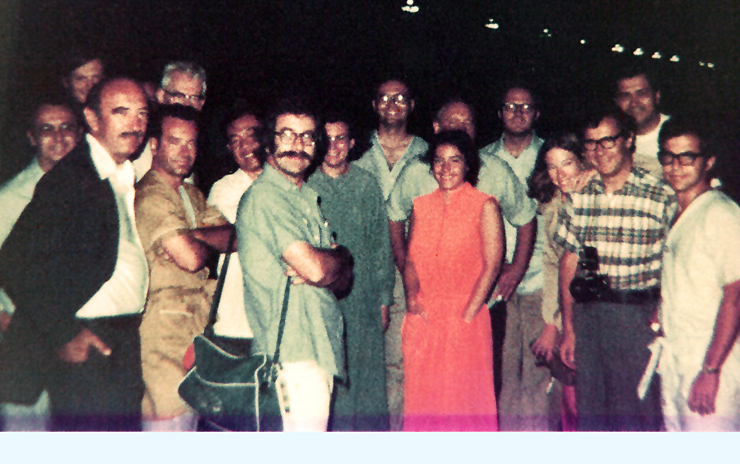
The 2007 Congressional staff delegation to China
In 2010, staff visit a solar panel manufacturer
An August 2011 visit to a subway station under construction in Wuhan
A December 2011 visit to a US multinational in Tianjin's Binhai New Area
Members of the May 2012 visit meet with local Ningxia residents
The National Committee, after a several-year hiatus, resumed sending delegations of Congressional senior staff members to China in 2007. Under the U.S. Mutual Education and Cultural Exchange Act of 1961 (MECEA) arrangement, these eight-day visits are conducted with the assistance of either the Foreign Affairs Committee of the National People's Congress or the Chinese People's Institute for Foreign Affairs. Largely listening tours for the participants to get a clearer understanding of China's accomplishments and challenges, they complement the Committee’s other efforts e.g., Congressional Member delegations and Capitol Hill briefings for new Members of Congress to educate Congress on issues relating to China.
Selected with the help of the bipartisan House US-China Working Group, staff participants have the chance to meet with counterparts working for China's legislature as well as with officials at the central, provincial and municipal levels and NGO leaders, academics, and members of the media. Discussions and visits focus on key issues in the U.S.-China relationship, such as energy, climate change, security, and trade. Each group is accompanied by several knowledgeable escorts: a senior staff member from the National Committee, staffers from of the Chinese counterpart organization, and (typically) an American China scholar. The National Committee works closely with our counterparts at the Chinese Embassy and host organization to develop the itinerary.
Our latest visits have drawn staffers from both the House and Senate. Delegations are composed either of D.C. staff members or State and District staff members.
Most recently, the National Committee ran two such delegation visits for senior Senate and House staff members from State and District offices. In December 2011, a staff delegation traveled to Beijing, Tianjin, and Xiamen, with side excursions to Fujian's Nanjing and Anxi counties. In May 2012, a similarly composed group traveled to Beijing and Ningxia. Both delegations focused on a broad set of key issues in the bilateral relationship: trade, security, energy, education, domestic politics, economics, and more.
Previous delegations have also included groups composed of senior staff from D.C. offices. In August 2011, a D.C. staff delegation traveled to Beijing, Tianjin, and Wuhan, to focus on China's investment in its own transportation infrastructure development. The group had opportunities to hear from Chinese and U.S. officials about the expansion of China's high-speed rail, river and ocean ports, highway, subway and light rail, and air transportation network — while experiencing much of it firsthand. In June 2010, a similar staff delegation traveled to Beijing, Chongqing, and Shanghai focused on economic and trade issues.
Prior staff delegations have concentrated on other aspects of China’s development and of the U.S.-China relationship, including China’s emerging alternative energy sector, minority issues, energy security, efforts to combat terrorism and narcotics trafficking, and economic development.
These programs continue the National Committee's long history of organizing and executing U.S. Congressional staff trips to China in 1976, we took the first group of Congressional staffers to China deepening the Committee's close working relationships with the US-China Working Group, the National People’s Congress, and the Chinese Embassy.
at a glance
- Last held: December 4-13, 2012; next planned for summer 2013
- Goal: Informing policy leaders & opinion shapers
- Type: Study Tour
- Category: Governance & Civil Society, Next Generation Leaders, Politics & Security, Transnational Issues
- Keywords: Congress, policy makers, Security, U.S. foreign policy
- Program Venues: Beijing, Chongqing, Hohhot INNER MONGOLIA, Nanjing JIANGSU, Shanghai, Tianjin, Wuhan HUBEI, Wuxi JIANGSU, Xilinhot INNER MONGOLIA, Yinchuan NINGXIA
- Program Funder(s): Chinese People's Institute for Foreign Affairs, Embassy of the People's Republic of China to the United States, National People’s Congress, The Starr Foundation
- Program Partner(s): Chinese Embassy, Chinese People's Institute for Foreign Affairs, Congressional Liaison Office, Foreign Affairs Committee, National People's Congress
- Administered by: Jan Berris, Jonathan Lowet
