Monday, March 9, 2026 | 12:00 PM EDT
On February 28, 2026, the United States and Israel launched a major military campaign against Iran, resulting in the assassination of Supreme Leader Ayatollah Ali Khamenei. The campaign triggered a rapidly evolving crisis across the Middle East, disrupting energy markets, closing Gulf airspace and waterways, and sending geopolitical and diplomatic shockwaves through the region, including casting uncertainty over the anticipated Trump-Xi summit at the end of March.
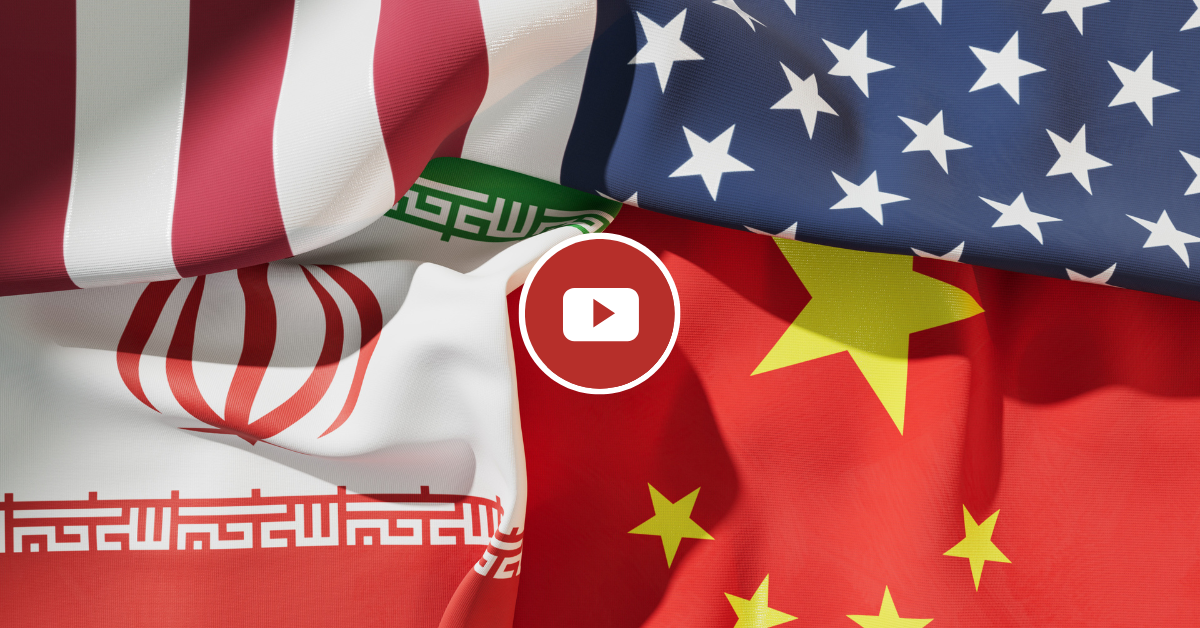
In an event recorded on March 9, 2026, Yun Sun and Gedaliah Afterman, in conversation with Lincoln Hines, unpack how the Iran war is testing China’s relationships across the Middle East, what Beijing’s response reveals about the limits of its regional influence, and what a fundamentally reshaped Middle East, potentially including a post-Islamic Republic Iran, means for the broader trajectory of U.S.-China relations.
Speakers

Gedaliah Afterman
Dr. Gedaliah Afterman is head of the Asia Policy Program at the Abba Eban Institute for Diplomacy and International Relations at Reichman University and a fellow at the Centre for Advanced Security, Strategic and Integration Studies (CASSIS) at the University of Bonn. A former Australian diplomat in Beijing, he previously worked on Asian regional security at Australia’s Department of Foreign Affairs and Trade. He writes widely on Chinese foreign policy, Asian security, and the evolving role of middle powers in the Middle East and Asia. Dr. Afterman holds a BA in philosophy from the Hebrew University of Jerusalem and a Ph.D. from the University of Melbourne.

Yun Sun
Yun Sun is a senior fellow and director of the China Program at the Stimson Center. Her expertise is in Chinese foreign policy, U.S.-China relations, and China’s relations with neighboring countries and authoritarian regimes. From 2011 to early 2014, she was a visiting fellow at the Brookings Institution, jointly appointed by the Foreign Policy Program and the Global Development Program, where she focused on Chinese national security decision-making processes and China-Africa relations. From 2008 to 2011, Dr. Sun was the China analyst for the International Crisis Group (ICG) based in Beijing, specializing in China’s foreign policy towards conflict countries and the developing world. Prior to the ICG, she worked on U.S.-Asia relations in Washington, D.C. for five years. Dr. Sun earned her Ph.D. from Johns Hopkins University.
Moderator

Lincoln Hines
Lincoln Hines is an assistant professor in the Sam Nunn School of International Affairs at the Georgia Institute of Technology. Previously, he was an assistant professor for the West Space Seminar at the U.S. Air War College. His research focuses on Chinese foreign policy and security, the politics of outer space, public opinion, and questions regarding status and nationalism in world politics. His research and policy commentaries have appeared in outlets such as Research & Politics, Space Policy, New Space, The Washington Quarterly, and The Washington Post. Previously, he was a Guggenheim predoctoral fellow at the National Air and Space Museum and a nonresident WSD-Handa Fellow at the Pacific Forum. He holds a Ph.D. in government from Cornell University, an MA in international affairs from American University’s School of International Service, and a BA in foreign affairs and East Asian studies from the University of Virginia.